ALL FESTIVALS AND EVENTS INDIA CELEBRATING

smart phone

11:33 PM
Click this image for read full article.

smart phone smart phone Reviewed by My Bloge on 11:33 PM Rating: 5

Saraswati Puja 2019 Festivals

11:09 PM
Saraswati (Sanskrit: सरस्वती, Sarasvatī) is that the Hindu divinity of data, music, art, wisdom, and learning.She could be a a part of the trinity (Tridevi) of Saraswati, Lakshmi, and Parvati. All the 3 forms facilitate the trinity of Brahma, Vishnu, and Shiva to form, maintain, and regenerate-recycle the Universe, severally.
Saraswati Puja 2019 Festivals


Saraswati Puja 2019 Festivals


The earliest proverbial mention of Saraswati as a divinity is within the Rigveda. She has remained important as a divinity from the Vedic amount through times of Hindu traditions.Some Hindus celebrate the competition of Vasant Panchami (the fifth day of spring, and additionally called Saraswati Puja and Saraswati Jayanti in such a lot of components of India) in her honour, and mark the day by serving to young kids find out how to write down alphabets thereon day.[6] The divinity is additionally revered by believers of the faith faith of west and central Republic of India,as well as some Buddhist sects.

Sarasvati, could be a Indic fusion word of saras (सरस्) which means "pooling water", however additionally generally translated as "speech"; and vati (वती) which means "she UN agency possesses" (also found within the name of Parvati, "She UN agency has wings"). Originally related to the stream or rivers called Saraswati, this mix so means that "she UN agency has ponds, lakes, and pooling water" or often "she UN agency possesses speech". it's additionally a Indic composite word of surasa-vati (सुरस-वति) which suggests "one with many water".


The word Saraswati seems each as a respect to a stream and as a major supernatural being within the Rigveda. In initial passages, the word refers to the Hindu deity stream and is mentioned joined among many northwestern Indian rivers like the Drishadvati. Saraswati, then, connotes a stream supernatural being. In Book 2, the Rigveda describes Saraswati because the better of mothers, of rivers, of god.


Saraswati is widely known as a female supernatural being with healing and purifying powers of plentiful, flowing waters in Book ten of the Rigveda, as follow


In religious writing, Saraswati acquires a similar significance for early Indians (states John Muir) as that authorised to the stream Ganges by their fashionable descendants. In hymns of Book ten of Rigveda, she is already declared to be the "possessor of knowledge".Her importance grows in Vedas composed once Rigveda and in Brahmanas, and also the word evolves in its which means from "waters that purify", to "that that purifies", to "vach (speech) that purifies", to "knowledge that purifies", and ultimately into a religious conception of a divinity that embodies data, arts, music, melody, muse, language, rhetoric, eloquence, artistic work and something whose flow purifies the essence and self of an individual.In Upanishads and Dharma Sastras, Saraswati is invoked to prompt the reader to meditate on virtue, virtuous emoluments, the which means and also the terribly essence of one's activity, one's action.


Saraswati is understood by several names in ancient Hindu literature. Some samples of synonyms for Saraswati embrace Brahmani (power of Brahma), Brahmi (goddess of sciences),Bharadi (goddess of history), Vani and Vachi (both concerning the flow of music/song, melodious speech, fluent speaking respectively), Varnesvari (goddess of letters), Kavijihvagravasini (one UN agency dwells on the tongue of poets). divinity Saraswati is additionally called Vidyadatri (Goddess UN agency provides knowledge), Veenavadini (Goddess UN agency plays veena, the instrument command by divinity Saraswati), Pustakdharini (Goddess carrying book with herself), Veenapani (Goddess carrying veena in her hands), Hansavahini (Goddess UN agency sits on swan) and Vagdevi (Goddess of speech).

In the Hindi language, her name is written Hindi: सरस्वती. within the Telugu, Hindu deity is additionally called Chaduvula Thalli  and Shārada . In Konkani, she is stated as Shārada, Veenapani, Pustakadhārini, Vidyadāyini. In Kannada, variants of her name embrace Sharade, Sharadamba, Vāni, Veenapani within the famed Sringeri temple. In Tamil, she is additionally called Kalaimagal (கலைமகள்), Kalaivāni (கலைவாணி), Vāni (வாணி) and Bharathi. She is additionally addressed  as Sāradā (the one UN agency offers sāra or the essence), Shāradā (the one UN agency loves the season season), Veenā-pustaka-dhārini (the one holding books and a Veena), Vāgdevi, Vāgishvari, (both which means "goddess of speech"), Vāni (speech), Varadhanāyaki (the one bestowing boons), Sāvitri (consort of Brahma), Gāyatri (mother of Vedas).[citation needed]

Saraswati Puja 2019 Festivals


In India, she is regionally spelled as Bengali: সরস্বতী, Saraswati ?, Malayalam: Saraswati ?, and Tamil:  In Odia as Saraswati.


Outside Asian country and Republic of India, she is understood in Burmese as Thurathadi pronounced or  or Tipitaka Medaw pronounced  in Chinese as Biàncáitiān  in Japanese as Benzaiten and in Thai as Suratsawadi or Saratsawadi
Saraswati Puja 2019 Festivals Saraswati Puja 2019 Festivals Reviewed by My Bloge on 11:09 PM Rating: 5

Missionary Day 2019 india

12:07 AM
Missionary Day 2019 is territorial occasion in Mizoram, India that celebrates the entry of two Welsh Christian evangelists in the state over a century back.
January 11 is an open occasion called "Missionary Day 2019" in Mizoram. It honors the entry of the initial two Christian teachers to the zone in 1894.

It was through the service of two Welsh ministers, the Reverends Lorrain and Savidge, that the town of Sairang and different zones of the Lushai Hills and Mizoram state were changed over to Christianity. These ministers made a Mizo-English word reference and started to encourage the Mizo individuals to peruse in their very own dialect. The showed them the Gospel, which changed their entire lifestyle from their past animism.

Missionary Day 2019


Prior, the general population of the Lushai Hills had struck British estates in the swamps toward the south, and notwithstanding when British India extended to incorporate their domain, they were just "inexactly controlled". However, starting with the 11 January 1894 undertaking of these two Presbyterian ministers, the majority of that started to change until the end of time.

The Presbyterian Church in Mizoram began observing Missionary Day 2019 in 1974, and the state government in the long run made it an open occasion. Many go to extraordinary administrations on this day, particularly in Presbyterian and Baptist houses of worship, for petition, love of God, and recognition of the endowments he sent through the landing of the Gospel with Mizoram's initial two ministers in 1894.

History of Missionary Day 2019


Rev J H Lorrain and Rev F W Savidge touched base in the then Lushai nation (Mizoram) by vessel from Assam on 11 January 1894 to spread Christianity in the district. This brought about change of all the Mizos to the new religion.

The Missionary Day 2019 built up the Presbyterian Church in northern piece of Mizoram and the Baptist Church in the southern piece of the state.

To stamp the day, nearby houses of worship will hold supplications and sort out network feasts.
Missionary Day 2019 india Missionary Day 2019 india Reviewed by My Bloge on 12:07 AM Rating: 5

Nag Panchami 2018 in India

10:26 AM
Nag Panchami 2018 in India

Nag Panchami in 2018 is on the Wednesday, 15th of Aug (8/15/20180)
Nag Panchami 2018 date in India : नाग पंचमी के पर्व पर नागराज व उनके वंश की पूजा की जाती है और साथ ही महादेव का आशीर्वाद भी प्राप्‍त किया जाता है। 
 श्रावण महिने  के शुक्ल पक्ष की पंचमी तिथि को नाग पंचमी मनाया जाता है। इस मौके पर नाग की पूजा होती  है। पूजा के समय  सर्प के 12 रूप  को  शामिल किए जाने की परंपरा  हैं।मान्यता है कि पूजा से अगर नागराज प्रसन्‍न होते हैं तो  महादेव की विशेष कृपा मिलती है।


Nag Panchami 2018 in India 

इस दिन जहा-जहा नागो का निबास होता है जैसे - तालाब,गड्ढा आदि जगहों पर पूजा किया जाता है । इस दौरान नागों से  अपनी व परिवार की रक्षा की प्रार्थना की जाती है। बता दें क‍ि सर्प को काल का प्रतीक भी माना गया है। शिव जी के गले से भी सर्प लिपटा रहता है।


Nag Panchami 2018 date and time
2018 में नाग पंचमी 15 अगस्त को है। इस द‍िन बुधवार है। ज्‍योतिषाचार्य सुजीत जी महाराज के अनुसार नाग पंचमी की पूजा का मुहूर्त सुबह 05:54 से 08:30 तक है। वहीं नाग पंचमी 15 अगस्त को तड़के 03:27 पर प्रारम्भ होगी और 16 की रात्र‍ि 01:51 पर समाप्त होगी
Nag Panchami 2018 पर कैसे करें पूजा 
महिलाये इस दिन नाग का चित्र बना कर पूजा करती है । सबसे  पहले शिव जी की पूजा होती है। कालसर्प दोष से पीड़ित लोग इस दिन विशेष पूजन कर इसकी शांति कराते हैं। इस दिन दुग्ध से रुद्राभिषेक कराने से प्रत्येक मनोकामना की पूर्ति होती है। प्रसाद में लावा और दूध बांटते हैं। जिनकी कुंडली राहु से पीड़ित हो, वो इस दिन रुद्राभिषेक अवश्य करें।


Nag Panchami 2018 in India Nag Panchami 2018 in India Reviewed by My Bloge on 10:26 AM Rating: 5

how to celebrate Muharram 2018 in india or world

3:36 AM

Celebrate Muharram 2018 in india or world

 Muharram 2018 in india or world

Muharram 2018 celebrated on Tuesday, (11/9/2018) and will continue for 29 days until Tuesday, the ninth of October.

Note that in the Muslim calander, an occasion starts on the nightfall of the earlier day, so watching Muslims will observe Al-Hijra/Muharram on the dusk of Monday, the tenth of September.


In spite of the fact that Al-Hijra/Muharram is dependably around the same time of the Islamic timetable, the date on the Gregorian schedule fluctuates from year to year, since the Gregorian date-book is a sun based logbook and the Islamic date-book is a lunar date-book. This distinction implies Al-Hijra/Muharram moves in the Gregorian logbook roughly 11 days consistently. The date of Al-Hijra/Muharram may likewise fluctuate from nation to nation contingent upon whether the moon has been located or not.

Muḥarram (Arabic: مُحَرَّم‎ muḥarram) is the main month of the Islamic date-book. It is one of the four sacrosanct long stretches of the year.[1] It is held to be the holiest month, Ramadan coming after. "Muharram" signifies "illegal". Since the Islamic date-book is a lunar date-book, Muharram moves from year to year when contrasted and the Gregorian logbook.
. Sunni Muslims speedy in the midst of this day, since it is recorded in the hadith[2] that Musa (Moses) and his family got a triumph over the Egyptian Pharaoh on the tenth day of Muharram; as needs be Muhammad requested that Muslims quick on this day that is Ashura and on multi day before that is ninth (called Tasu'a). Shia Muslims grieve the passing of Imam Hussein (as )and his family, regarding the forfeit of the saints by supplicating in plenitude and shunning every single blissful occasion.

In the midst of Muharram, Shia Muslims do unmistakable things and with different objectives. Muhammad and child of Ali, in the Battle of Karbala. They grieve for Hussein ibn Ali and shun every single upbeat occasion.Not at all like Sunni Muslims, Shias don't fast on the tenth day of Muharram.[3] what's more there is an imperative Ziyarat book, the Ziyarat Ashura about Hussein ibn Ali.In the Shia aggregate it is well known to scrutinize this ziyarat "Upon the entry of Ashura", but the huge majorit of the Shias endeavor to peruse Ziyarat Ashura consistently and they send welcome to Hussein ibn Ali.[4]


Muharram and Ashura

With the locating of the new moon, the Islamic New Year is introduced. The fundamental month, Muharram, is one of the four sanctified months that Allah has said in the Quran: Muharram, Rajab, Dhu al-Qi'dah, and Dhu al-Hijjah. Indeed, even before Islam came, Quraish and Arabs all in all knew the holiness of the months and were taboo to take up arms against those months.

Muharram and Ashura to the Shia

Muharram is multi month of recognition and present day Shia contemplation that is regularly viewed as synonymous with Ashura. Ashura, which truly implies the "Tenth" in Arabic, alludes to the tenth day of Muharram. It is outstanding a direct result of authentic essentialness and grieving for the murder of Hussein ibn Ali, the grandson of Muhammad.[5]

Shiite start grieving from the main night of Muharram and proceed for ten evenings, peaking on the tenth of Muharram, known as the Day of Ashura. The most recent couple of days up until and including the Day of Ashura are the most imperative in light of the fact that these were the days in which Imam Hussein and his family and supporters (counting ladies, youngsters and elderly individuals) were denied of water from the seventh forward and on the tenth, Imam Hussain and 72 of his adherents were killed by the armed force of Yazid I at the Battle of Karbala on Yazid's requests. The surviving individuals from Imam Hussein's family and those of his devotees were kidnapped, walked to Damascus, and detained there.
Occurrences happened amid this month

 Muharram:  Shia Muslims spend the day in grieving, while the Sunni Muslims quick on this day remembering the save of the general population of Israel by Musa (Moses) from Pharaoh[9]

Numerous Sufi Muslims quick for an indistinguishable reason from the Sunnis said above, yet in addition for the martyred individuals in Karbala, they petition God for them and send upon them peace and gifts.

 Muharram, Maytham al-Tammar was martyred.

Passing commemoration Urs of Baba Farid, an extraordinary Sufi holy person in Pakistan for six days in Muharram
how to celebrate Muharram 2018 in india or world how to celebrate Muharram 2018 in india or world Reviewed by My Bloge on 3:36 AM Rating: 5
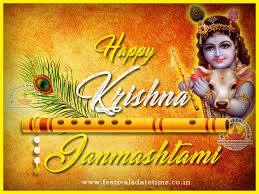
janmashtami 2018

1:23 AM

janmashtami 2018

janmashtami 2018

janmashtami 2018 is a Hindu celebration and a asion in numerous areas of IGazetted occndia.
It might be known as Sreekrishna Jayanthi in a few areas. ​According to the Hindu date-book, janmashtami 2018 is praised on the Ashtami (eighth day) of Krishna Paksha (dull fortnight) in the long stretch of Shravana or Bhadra (in the Hindu timetable, there is a jump month once like clockwork).
Janmashtami is likewise an open occasion in Bangladesh.
On 2 September 2018, Janmashtami is an open occasion in Tamil Nadu.
On 3 September 2018, Janmashtami is an open occasion in Assam, Bihar, Chandigarah, Chhattisgarh, Delhi, Gujarat, Haryana, Himachal Pradesh, Jammu and Kashmir, Jharkhand, Madhya Pradesh, Meghalaya, Nagaland, Punjab, Rajasthan, Sikkim, Telangana, Tripura, Uttar Pradesh, Uttarakhand
Krishna Janmashtami likewise referred to just as Janmashtami or Gokulashtami, is a yearly Hindu celebration that commends the introduction of Krishna, the eighth symbol of Vishnu.[3] It is seen by Hindu luni-sunlight based timetable, on the eighth day (Ashtami) of the Krishna Paksha (dull fortnight) in the long stretch of Shraavana of the Hindu Calendar, which covers with August and September of the Gregorian calendar.

It is an essential celebration especially to the Vaishnavism convention of Hinduism.[4] Dance-show institutions of the life of Krishna as indicated by the Bhagavata Purana, (for example, Rasa lila or Krishna Lila), reverential singing through the midnight when Krishna is accepted to have been conceived, fasting (upavasa), a night vigil (jagarana), and a celebration (mahotsava) on the next day are a piece of the Janmashtami celebrations.[5] It is commended especially in Mathura and Brindavan, alongside significant Vaishnava people group found in Manipur, Assam, West Bengal, Odisha, Madhya Pradesh, Rajasthan, Gujarat, Maharashtra, Karnataka, Kerala, Tamil Nadu, Andhra Pradesh and other regions.[3][6]

Krishna Janmashtami is trailed by the celebration Nandotsav, which commends the event when Nanda Baba circulated blessings to the network to pay tribute to the birth.[7]

Krishna was the child of Devaki and Vasudeva and his birthday is commended by Hindus as Janmashtami, especially those of the Vaishnavism custom as he is viewed as the eighth symbol of Vishnu.[8][9] Janmashtami is praised when Krishna is accepted to have been conceived by Hindu convention, which is in Mathura, at midnight on the eighth day of Shraavana month (covers with August and September in the Gregorian calendar).[3][10]

Krishna was conceived in a time of tumult, abuse was uncontrolled, flexibilities were denied, detestable was all over the place, and when there was a risk to his life by his uncle King Kamsa.[11] Immediately following the birth, his dad Vasudeva took Krishna crosswise over Yamuna, to temporary parents in Gokul, named Nanda and Yashoda.[12] This legend is praised on Janmashtami by individuals keeping quick, singing reverential tunes of affection for Krishna, and keeping a vigil into the night.[13] After Krishna's midnight hour birth, statues of child Krishna are washed and dressed, at that point set in a support. The fans at that point break their quick, by sharing sustenance and desserts. Ladies draw modest impressions outside their home entryways and kitchen, strolling towards their home, an imagery for Krishna's adventure into their home.

Festivities janmashtami 2018

janmashtami 2018

Hindus observe Janmashtami by fasting, singing, asking together, getting ready and sharing extraordinary sustenance, night vigils and going to Krishna or Vishnu sanctuaries. Significant Krishna sanctuaries sort out recitation of Bhagavata Purana and Bhagavad Gita.[14] Many people group arrange move dramatization occasions called Rasa Lila or Krishna Lila.[13] The convention of Rasa Lila is especially well known in Mathura area, in northeastern conditions of India, for example, Manipur and Assam, and in parts of Rajasthan and Gujarat. It is carried on by various groups of novice specialists, gived a shout out to by their neighborhood networks, and these dramatization move plays start a couple of days before each Janmashtami
janmashtami 2018 janmashtami 2018 Reviewed by My Bloge on 1:23 AM Rating: 5

Raksha Bandhan 2018

3:05 AM

Raksha Bandhan 2018

Raksha Bandhan 2018

Raksha Bandhan 2018 is celebrated on Saturday, the 25th of August(25/8/2018).
Raksha Bandhan2018 is celebrated in Shravana month during full moon day or Purnima day.
Raksha Bandhan, additionally Rakshabandhan, or basically Rakhi, is a yearly ceremony performed in the Indian subcontinent, or by individuals starting from the Indian subcontinent, and based on the tying of a string, charm, or talisman on the wrist as a type of custom security. The assurance is offered mainly by sisters to siblings, yet in addition by clerics to supporters, and here and there by people to genuine or potential sponsors. Contrasting variants of the ceremony have been generally performed by Hindus in northern India, western India, Nepal,and previous provinces of the British Empire to which Hindus had emigrated from India in the nineteenth century, and have included, also, ceremonies with names rendered as Saluno, Silono, and Rakri. The customs related with these rituals, be that as it may, have spread past their conventional areas and have been changed through innovation and migration, the movies, social interaction, and advancement by politicized Hinduism, and in addition by the country state.

Raksha Bandhan is seen on the most recent day of the Hindu lunar schedule month of Shraavana, which commonly falls in August. On this day, sisters of any age tie a charm, or talisman, called the rakhi, around the wrists of their siblings, ceremonially ensuring their siblings, getting a blessing from them consequently, and customarily contributing the siblings with an offer of the duty of their potential care. The articulation "Raksha Bandhan," Sanskrit, truly, "the obligation of insurance, commitment, or care," is currently primarily connected to this custom. It has likewise connected to a comparable custom in which a residential minister ties talismans, charms, or strings on the wrists of his benefactors and gets endowments of money. A custom related with Saluno incorporates the sisters putting shoots of grain behind the ears of their brothers.


Of extraordinary criticalness to wedded ladies, Raksha Bandhan is established in the act of regional exogamy, in which a lady of the hour weds out of her natal town or town, and her folks, by custom, don't visit her in her wedded home. In rustic north India, where regional exogamy is emphatically pervasive, substantial quantities of wedded Hindu ladies head out back to their folks' homes each year for the ceremony. Their siblings, who normally live with the guardians or adjacent, in some cases travel to their sisters' hitched home to escort them back. Numerous more youthful wedded ladies arrive fourteen days sooner at their natal homes and remain until the ceremony. The siblings fill in as long lasting middle people between their sisters' hitched and parental homes, and also potential stewards of their security. In urban India, where families are progressively atomic, and relational unions not generally customary, the celebration has turned out to be more emblematic, however keeps on being exceptionally prominent.

Among ladies and men who are not blood relatives, there is likewise a changed custom of deliberate family relations, accomplished through the tying of rakhi ornaments, which have played hooky lines,[ and Hindu and Muslim divisions. In a few networks or settings, different figures, for example, a matron, or a man in expert, can be incorporated into the function in custom affirmation of their benefaction.[ Raksha Bandhan is additionally celebrated by Hindu people group in different parts of the world. Although established in Hindu culture, the celebration has no conventional petitions unambiguously connected with it. The religious fantasies asserted for it are questioned, and the recorded stories related with it considered spurious by some historians. More as of late, after establishment of more sexually impartial legacy laws in India, it has been proposed that in a few networks the celebration has seen a resurgence of festivity, which is serving to in a roundabout way weight ladies to refuse completely guaranteeing their inheritance.

Raksha Bandhan 2018

Raksha Bandhan 2018

Rajendra Prasad, the principal leader of the Republic of India observing Raksha Bandhan at the presidential royal residence, Rashtrapati Bhawan in New Delhi, 24 August 1953

As indicated by R. S. McGregor's Oxford Hindi-English Dictionary, 1993, the name of the celebration, the manly Hindi thing rakśābandhan is made out of the Sanskrit loanword rakśā, a female thing, which signifies, "insurance," "protection," or "mind." and a second Sanskrit loanword bandhan, a manly thing, which signifies "affixing," or "binds together."[34] According to V. S. Apte's Revised Practical Sanskrit-English Dictionary, 1957– 1959, रक्षा articulated rakṣā signifies, "insurance," "protection," or "guarding;" बन्धन articulated, "bandhana," signifies "The demonstration of authoritative, securing, tying."
As per McGregor, the Hindi female thing, rākhī, (which is contrasted etymologically with rakśā depicted above) is a "defensive charm: a bit of string and so forth., with a rosette, tied ceremoniously cycle a defender or benefactor's wrist on the full moon of the month Srāvan: particularly by a sister cycle a sibling's wrist, when the sibling gives a little endowment of money."[37] interestingly, Apte characterizes one of the auxiliary significance of रक्षा (rakṣā) to be: "A bit of silk or string secured round the wrist on specific events, particularly on the full-moon day of Śrāvaṇa, as a talisman or additive; (रक्षी (rakṣī) additionally in this sense).

As per Jack Goody, rakśābandhan is "related with the Sanskrit name for marriage, saṃbandhan, where the normal component bandhan (Sanskrit: bandhá) alludes to the demonstration of tying. The functions are correlative. Marriage (sam, correspondingly) ties life partners; rakśābandhan ties sibling and sister."[38]

Raksha Bandhan 2018


Researchers who have expounded on the custom, have normally depicted the conventional district of its recognition as north India; in any case, likewise included are: focal India, western India and Nepal, also different locales of India, and abroad Hindu people group, for example, in Fiji. Anthropologist Jack Goody, whose field examine was directed in Nandol, in Gujarat, portrays Rakshabandhan as a "yearly service ... of northern and western India."[39] Anthropologist Michael Jackson, states, "While customary North Indian families don't have a Father's or Mother's Day, or even what might as well be called Valentine's Day, there is a Sister's Day, called Raksha Bandhan, ..."[40] Religious researcher J. Gordon Melton portrays it as "basically a North Indian festival."[41] Leona M. Anderson and Pamela D. Youthful depict it as "a standout amongst the most prominent celebrations of North India."[42] Anthropologist David G. Mandelbaum has portrayed it as "a yearly custom saw in northern and western India."[43] Other portrayals of essential districts are of advancement business analyst Bina Agarwal ("In Northern India and Nepal this is ritualized in celebrations, for example, raksha-bandhan."), researcher and dissident Ruth Vanita ("a celebration broadly celebrated in north India."), anthropologist James D. Faubion ("In north India this sibling sister relationship is formalized in the service of 'Rakshabandhan.'"), and social researcher Prem Chowdhry ("... in the perceptible restoration of the Raksha Bandhan celebration and the recharged holiness is has guaranteed in North India.").

Raksha Bandhan 2018


Anthropologist McKim Marriott in his "Little Communities in an Indigenous Civilization," (1955) portrays a "vast" convention of Rakhi-bandhan, or Raksha-bandhan, in which a minister ties charms around their benefactors' wrists and gets endowments of cash, and a neighborhood custom of Saluno in Aligarh area of North India in which sisters put ears of holy grains on the heads and behind the ears of their sibling in assertion of the sibling's part as their genuine or potential protector.Marriott's work likewise depicts the field investigation of anthropologist Alan R. Beals in Namhalli, a town close Bangalore, who notes changes in the rakhi custom expedited by current technology.

While Raksha Bandhan is commended in different parts of the Indian subcontinent, diverse districts check the day in various ways.

In the province of West Bengal and Odisha, this day is additionally called Jhulan Purnima. Petitions and puja of Lord Krishna and Radha are performed there. Sisters attach rakhi to siblings and wish everlasting status. Political gatherings, workplaces, companions, schools to universities, road to royal residence praise this day with another desire for a decent relationship.[citation needed]

In Maharashtra, the celebration of Raksha Bandhan is praised alongside Narali Poornima (coconut day celebration). Kolis are the anglers network of the waterfront state. The anglers offer petitions to Lord Varuna, the Hindu divine force of Sea, to summon his endowments. As a major aspect of the customs, coconuts were tossed into the ocean as contributions to Lord Varuna. The young ladies and ladies tie rakhi on their sibling's wrist, as elsewhere.

In the locales of North India, for the most part Jammu, it is a typical practice to fly kites on the adjacent events of Janamashtami and Raksha Bandhan. It's not irregular to see the sky loaded with kites of every kind imaginable, nearby these two dates. Local people purchase kilometers of solid kite string, generally called as "gattu entryway" in the nearby dialect, alongside a large number of kites.[citation needed]

In Haryana, notwithstanding observing Raksha Bandhan, individuals watch the celebration of Salono. Salono is praised by ministers seriously tying talismans against fiendish on individuals' wrists. As somewhere else, sisters tie strings on siblings with petitions for their prosperity, and the siblings give her blessings promising to defend her.

In Nepal, Raksha Bandhan is alluded to as Janai Purnima or Rishitarpani, and includes a holy string service. It is seen by the two Hindus and Buddhists of Nepal. The Hindu men change the string they wear around their chests (janai), while in a few sections of Nepal young ladies and ladies tie rakhi on their sibling's wrists. The Raksha Bandhan-like sibling sister celebration is seen by different Hindus of Nepal amid one of the times of the Tihar (or Diwali) festival.

The celebration is seen by the Shaiva Hindus, and is prominently referred to in Newar people group as Gunhu Punhi.

Raksha Bandhan 2018


Rabindranath Tagore, the Indian Nobel Laureate for writing, summoned Raksha Bandhan and rakhi as ideas to rouse love, regard and a promise of shared security amongst Hindus and Muslims amid India's frontier era. In 1905, the British domain separated Bengal, a region of British India based on religion. Rabindra Nath Tagore orchestrated a service to observe Raksha Bandhan to fortify the power of profound devotion and harmony amongst Hindus and Muslims of Bengal, and urge them to together challenge the British realm. He utilized the possibility of Raksha Bandhan to spread the sentiment of fellowship. In 1911, British pioneer realm turned around the parcel and bound together Bengal, a unification that was restricted by Muslims of Bengal. At last, Tagore's Raksha Bandhan-based interests were unsuccessful. Bengal not exclusively was part amid the frontier period, one section wound up present day Bangladesh and prevalently Muslim nation, the other a to a great extent Hindu Indian province of West Bengal. Rabindranath Tagore began Rakhi Mahotsavas as an image of Bengal solidarity, and as a bigger network celebration of harmony. In parts of West Bengal, his custom proceeds as individuals attach rakhis to their neighbors and dear friends.

One of Tagore's lyric conjuring rakhi is
Raksha Bandhan 2018 Raksha Bandhan 2018 Reviewed by My Bloge on 3:05 AM Rating: 5
Powered by Blogger.